The lighter side of editing

The lighter side of editing
Showing posts with label Editing. Show all posts

Friday, September 22, 2017

Should You Hire Your Own Freelance Editor or Buy the Editing Package from Your Publisher?

These days, indie authors have choices upon choices to make when it comes time to have their work edited. One of the first is this:

Should you contract directly with an individual freelancer or buy an editing package through a self-publishing company?

The short and not very helpful answer is yes. That makes for an awfully short blog post though, so let’s try for a longer and more helpful response. I can’t respond to this question with a simple, one-size-fits-all answer, because there isn’t one (although “Hire me!” does come to mind). What I can do is give you some pros and cons to the two options from the editor’s perspective.

Finding Your Own Freelance Editor: Pros and Cons

Pros
  • Getting to know you. When you contract directly with a freelancer, you know who you’re dealing with. You can ask about that person’s experience, skills, and interests, and you can often request a sample edit that will show you what kinds of changes the editor will make, how he or she will make those changes, et cetera.
  • Access. If you have questions before, during, or after the edit, you can email your editor and get answers, often the same day.
  • Consistency. If you like the way an editor handled your first book, you can turn to the same person for your second book. This is especially important if you’re writing a series and want the editing choices to be consistent from volume to volume.

Smiling woman at computer
Want to know who your editor is? Hire a freelancer.
Photo via Adobe Stock.


Con
  • The search. It’s not easy to find the right freelancer. There are roughly a bazillion of us, and we’re all on the internet, just waiting for you to google “freelance editor.” I just did that, and Google came back with 21.1 million results in 0.78 seconds. If you’ve recently written your very first book and are looking to hire your very first editor, those numbers can look pretty darn intimidating. Try narrowing things down by plugging in more specific search terms; a search for “freelance science fiction editor” brought up 482,000 results. Better still, try going to the Editorial Freelancers Association (www.the-efa.org) and search for a freelancer in the member directory, or post your job on the job list (but be prepared for a lot of replies).


Buying an Editing Package from a Self-Publisher: Pros and Cons

Pros
  • It’s easy. Click a button, answer some questions, pay the fee. No searching required.
  • Quality control. When I do contract work for a self-publisher, the edited book goes through two rounds of quality control before it goes back to the author. No, that doesn’t guarantee perfection (nothing does), but it gets you a little closer. When I contract directly with an author, I have my own list of things to double-check at the end of an edit … but if there’s something I was blind to when I was knee deep in editing your book, I might still be blind to it when I’m in double-check mode.
  • Speed. In a hurry? Some freelancers are booked months in advance, but with the self-publisher there will usually be an editor ready to start on your book right away. Also, the deadlines are tight, at least in my experience. This means you can get your edited book back quickly (but read on to the “cons” section).

Hands on computer keyboard
The editor without a face.
A potential con to buying an editing package.
Photo via Adobe Stock.


Cons
  • Speed. Those tight deadlines mean editors work quickly, which, in my experience, means being less able to pay attention to nuances of language and usage and less engaged with the manuscript as a whole.
  • The editor without a face. One thing that has surprised me about editing is how intimate it can feel. Plunging your hands into someone else’s writing, adding punctuation, changing words, moving sentences, all while trying to get inside the author’s head so you don’t inadvertently change his or her meaning—that is something I do not take lightly. Because I know what editors actually do, I would be reluctant to turn any of my fiction writing over to a nameless, faceless “Editor.” I just wouldn’t be comfortable with it.
  • Consistency, lack of. This one is for those of you who write series. When you submit your second, third, or fourth book, you can request the same editor who worked on your previous book(s), but what if that person has moved on from that company? Your new editor will turn in a good, solid edit, but some of the little things, those little decisions editors make—whether to capitalize a certain word or retain a certain alternative spelling, for example—might be different. Not wrong; just different. Even if you do get the same editor, that person’s decisions could be different, simply because he or she likely will not remember or have any record of specific choices made in the past. When I edit for private clients, I always hang on to the style sheet I create, and I also send a copy to the author. When I do contract work, I still create a style sheet, but I don’t keep it after the job is finished, and the author does not get a copy. That means less consistency if I happen to edit for that author again in the future.
  • The editor does not work for you. An editor who works for or contracts with a self-publishing company works for the publisher, not for the author. Why does this matter? Well, it means that when I edit for a self-publisher, I follow their rules, and that means following The Chicago Manual of Style (16th edition) very closely. For most authors, this is fine. But for nonfiction manuscripts originally written in another style (MLA or APA, for example), this can mean lots and lots of fiddly changes that don’t do much to enhance the work. For some fiction manuscripts, it can mean imposing style guidelines that don’t quite fit. (Note that I said “for some fiction manuscripts”; in most cases, Chicago style works just fine for fiction.) When I work directly for an author (and specifically for authors of genre fiction), I don’t get all loosey-goosey with the style guidelines, but I do apply them a bit more flexibly.


The Takeaway


What does all this mean for the indie author? Well, if your work is straightforward, not very complex, not part of a series, and needs only light editing, then buying the editing package from a self-publisher could be a good choice for you. You’ll likely get a quality edit with a quick turnaround and at a fair price. But if your work is more complex—say, if it is written in dense language, has hundreds of footnotes and an extensive bibliography, or uses lots of special formatting or a quirky style that you want to keep—I would recommend taking the time to find your own editor. Same thing if your work is part of a series and you want the tenth book to have the same style as the first: find your own editor. Again, you will likely get a quality edit at a fair price, and you will potentially be starting a long-term relationship with a professional you’ll be able to turn to again and again.

Thursday, June 29, 2017

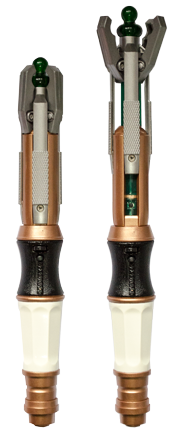
Lesser-Known Editing Tools Part 1: Sonic Screwdriver

Sonic Screwdriver--11th Doctor
The sonic screwdriver of the
11th Doctor. This is the model
we use.


Every profession has its tools. For editors, the toolkit generally includes a computer/monitor(s)/keyboard setup, word-processing software (usually Word), macros, shortcuts, reference materials (print and electronic), often a timer of some sort, perhaps a project management program, and the one tool without which none of this would work—the editor’s brain. Every once in a while, though, you’ll find yourself in an editing situation that calls for a different tool. A special tool. A tool that is not usually associated with editing. In this series, we’ll be taking a look at some of these lesser-known editing tools. Perhaps one or two of them will find a place in your editing toolkit.

Introducing the sonic screwdriver

Today’s tool is the sonic screwdriver.[1] If you are not familiar with the BBC series Doctor Who, you have perhaps never heard of this tool. The sonic screwdriver is the Doctor’s basic, all-purpose tool, useful for tasks such as picking locks, disabling or enabling electronics, picking up various sorts of signals … and, oddly enough, tightening and loosening screws.

But what can a sonic screwdriver do for you?

Peter Capaldi on set of Doctor Who
Peter Capaldi, the current
Doctor Who, photographed
on set.
Given that the sonic screwdriver is the tool the Doctor has relied on in many a tight situation, your friends at The Breaded Tortoise wondered if it might have some as yet undiscovered editing functions. We have discovered something miraculous.[2]

Every once in a while, you will come across a sentence (and we use the term loosely) that you just cannot figure out. The authors of these collections of words have hidden their true intentions so cleverly that normal editorial techniques fail. No amount of rereading, reading aloud, reading backward, staring, or swearing is helpful.

Time to break out the sonic screwdriver.[3]


Choose your model

Sonic screwdriver--12th Doctor
The 12th Doctor's sonic screwdriver. If you
want maximum functionality, this is the
model for you.
Sonic screwdrivers are available in several models, each corresponding to a particular Doctor. The current Doctor, played by Peter Capaldi, has a state-of-the-art screwdriver with more functions than our model has. We understand it has four light modes and four sound effects. We are fairly sure that some combination of light and sound would be useful in formatting notes and bibliographies. Some other combination could be used to fix problems with verb tenses. The possibilities are endless.[4]

Various models can be found on Amazon for between $12 and $30. For a device that can preserve your sanity, this is a steal.

How to operate a sonic screwdriver

Just point your screwdriver at the offending word or sentence, and press the button.[5] Easy peasy. But don't tell your clients that you're using a bit of British sci-fi equipment on their manuscripts. Best to let them think you're brilliant.


What’s the best fix your sonic screwdriver has made? Let us know in the comments!


 Photo credits:
Peter Capaldi. By Shaun Smith [CC BY-SA 2.0 (http://creativecommons.org/licenses/by-sa/2.0)], via Wikimedia Commons.

Eleventh Doctor's sonic screwdriver. By Sonicdrewdriver (Own work) [CC BY-SA 3.0 (http://creativecommons.org/licenses/by-sa/3.0)], via Wikimedia Commons.

The twelfth Doctor’s screwdriver. By Character Options [CC BY-SA 4.0 (http://creativecommons.org/licenses/by-sa/4.0)], via Wikimedia Commons.


[1] Disclaimer: The sonic screwdriver serves no actual editorial function and should not be relied upon in professional editing situations. Results depicted in this post are for illustration purposes only and are not guaranteed. The Breaded Tortoise just wants you to have a little fun with your work.
[2] Not really.
[3] The sentence shown in the video is very similar to one we encountered in the wild several years ago. A “crystal tear drop slanderer hanging from the sealing” is not something we could make up.
[4] Because we are making them up.
[5] Nothing will happen, but you might feel a bit better.

Thursday, March 2, 2017

Should I Format My Manuscript in Book Form Before I Submit It for Editing?

A manuscript submitted for editing should be neat but not print-ready
Image credit: Adobe Stock

Let’s make this simple. No. No, you should not do a lot of fancy formatting in your manuscript before you send it to an editor. As an author myself, I know how tempting it is to try out different fonts, heading styles, picture placement, and so on. You’ve worked on this thing for months or years, and you’re ready for it to start looking like an actual book. It’s time already, right?

Well, not so fast. There’s not much point in putting time into doing a pretty layout when the editor is just going to come along and screw it all up. For example, I’ve gotten my share of raw manuscripts that are set in some font—any font—other than good ol’ boring twelve-point Times New Roman. And the first thing I do to those manuscripts is change the font. My editing eyes are used to seeing twelve-point Times New Roman, and it seems like a bad idea to confuse them now.

How should you format your manuscript for editing?

Unless your editor/publisher tells you otherwise, just keep it simple:
  • Use a page size of 8.5 x 11 inches with one-inch margins.
  • Set your main text in twelve-point Times New Roman, double spaced.
  • Use a larger font size and/or bold to indicate section headings, chapter headings, and subheadings.
  • If your manuscript includes any unusual formatting that you want to keep (if you want certain sections set in a different font, for example), let your editor know.
  • If your book will include photos, illustrations, and so on, do not paste them directly into the manuscript file. Instead, add text such as “Insert figure 1 here” to keep track of where everything goes. I also prefer to have captions in a separate file rather than placed directly in the manuscript. This makes both editing and layout easier.

 Basically, you want it to look neat, but you don't need to worry about making it "print ready." First get the words right, and then worry about making it look pretty.

Thursday, October 13, 2016

One Editor’s Work Space

What can you find on an editor’s desk? Depends on the editor. Who cares what you can find on an editor’s desk? Other editors, mostly, because we are an inquisitive (nosy) lot. You never know when you might see one editor doing or using something brilliant that would work for you too. After years of adapting myself to inadequate and uncomfortable work spaces, I finally invested in one that works for me. Here it is:

Photo of desk with dual computer monitors.
Photo 1. The general work area.

  1. Dual monitors on fully adjustable monitor arms. How did I ever live without dual monitors? See below to find out how I use them.
  2. Sit/stand desk. Expensive but worth it, because this is where I spend my life. It’s an UPLIFT Desk from the Human Solution, by the way. Love it, love it, love it.
  3. Ergonomic keyboard. An absolute must. This one is a Kinesis Freestyle 2, plus the numeric keypad and an accessory kit.
  4. Balance-ball seating. I find this much more comfortable—and fun—than a chair. No, I’ve never fallen off, though I’ve come close a few times due to too much bouncing and/or rolling.
  5. Laptop stand that I use to hold books. I love this stand because it allows me to keep my style guide—usually Chicago—right at my side. It also has space below to hold my most frequently consulted sources.
  6. Hot-beverage center. What office is complete without a Keurig? Coffee in the morning + tea in the afternoon = a happy editor.


Photo of desktop.
Photo 2. The desktop.

  1. What’s on the dual monitors? I keep Pandora on all day, usually minimized on the left screen (it’s on screen in the photo). The left screen is also where I view my active document and its style sheet. The right screen is for the editorial letter (always open so I can make notes on it as I’m editing) and my Internet resources. I keep at least three tabs open pretty much all the time: the Merriam-Webster Unabridged Dictionary, the online Chicago manual, and a search engine.
  2. Water.
  3. Timer. I set this for 30 minutes, work until it beeps, and stand to stretch and move around a little. The timer reminds me to get up regularly if I’m sitting, and it also helps me track my time. No fancy time-tracking apps here; I just write the time in that notebook the timer is sitting on.
  4. Things that make me happy. A Grumpy Cat mug and an electronic screwdriver. If you don’t watch Doctor Who, the screwdriver may not make sense to you, but I keep this little beauty on my desk to help me out in tricky editing situations. Not sure how to untangle a jumble of words that is supposed to be a sentence? Just point the electronic screwdriver at the screen and… Okay, it doesn’t actually do anything, but it’s fun.
  5. Coffee and snacks.
  6. TARDIS. Also from Doctor Who. Bigger on the inside. When things get rough, I can fantasize about climbing in there and shooting off to some other place and time.

What's on your desk top?

Thursday, August 25, 2016

5 Phrases Guaranteed to Raise Your Editor’s Blood Pressure


I have high blood pressure. It’s controlled with diet, exercise, medication, and attitude, meaning I try to avoid overloading myself with stress. Unfortunately, sometimes editing is stressful. Wait…that’s not quite right. Editing is a joy. I love editing. When you’re bookin’ along through a manuscript, checking the dictionary, poring over entries in Chicago, updating your style sheet, hitting your keyboard combinations to insert autotext…Oh, yeah. Ever heard of flow? Anyway, the stress in editing doesn’t come from editing; it comes from people.

Before I proceed, I want to state very clearly that most authors and other folks I encounter are a joy to work with. But...

Every once in a while, an editor will run into a client who is demanding, overbearing, and/or just plain rude. There’s even a specific term for this kind of client: pita (“pain in the ass”; not to be confused with the yummy flatbread that goes great with hummus). These clients seem not to understand—or care—that the person on the receiving end of their e-mail is, well, a person. From some of these unfortunate encounters, I have put together the following list of phrases guaranteed to upset an editor’s equilibrium.


1. You left an error on page 97.

Of course this client won’t bother to mention that the rest of the book is perfect…and there is usually a good chance that the “error” is not an error at all.


2. I don’t think you read my book. You just ran some kind of spellcheck on it.

A client actually said this to me in an e-mail once, and it absolutely sent me into orbit. Maybe I should have been more, um, diplomatic, but I severed our working relationship immediately. Some things I just don't put up with.


3. You ruined my masterpiece!

If by “ruined” you mean “corrected the atrocious spelling and put the commas in the correct places,” then yes, I did, thankyouverymuch. Thankfully, I’ve never been on the receiving end of this particular insult.


4. Why did you change X, Y, or Z???!!! I demand that you change it back!

This came from an author who was absolutely outraged that I corrected the improper use of “lie” and “lay” throughout her book. By the way, I did not change it back, but I was very diplomatic in explaining why.


5. You want how much to edit my book? Pretty good money for just reading.

Sigh…For the umpteenmillionth time, editing is not “just reading.” This little comment was especially annoying because it hit my in-box on a beautiful Saturday afternoon when I was stuck in my basement office—working, all the livelong day, after having worked all week and the previous weekend.


If you want to insult and/or anger an editor, try one of these phrases out on him/her. Or, if you would prefer to have a productive working relationship with your editor, try a different approach. There is absolutely nothing wrong with disagreeing with your editor or asking questions about something the editor changed or didn’t change. Just remember: Editors are people too, and some of them already have high blood pressure.

Photo credit: Stock image via Adobe Stock.

Thursday, August 18, 2016

Editor Fails Grammar Quiz, Doesn’t Care


Several months ago, I—middle school grammar nerd, lifelong avid reader, editor for over a decade—failed a simple grammar quiz. And I don’t care.

What really happened

Okay, I did not “fail”; instead, I got what you might call an “interesting result.” And it wasn’t a grammar quiz, exactly. It was more of an “Are you a grammar nazi?”* quiz—you know, one of those things you stumble across on Facebook and click on because you think it’ll be an excellent way to waste ten minutes of your life? Yeah, you should just steer clear of those quizzes. Life is too short.

Anyway, the quiz comprised ten or so questions, each of which presented a sentence containing a possible error. The quiz taker’s task was to decide how to fix the sentence, or whether to fix it at all. The possible errors were things like use of ain’t in a sentence. They were things that, in the context of formal prose (e.g., for your dissertation), would be problematic. But in another context (e.g., fiction narrated by a character whose grammar is more, um, casual), they might be fine, and the suggested fixes would be stilted and would suck the author’s voice right out of the piece.

Ten out of ten, I chose “The sentence is fine as is.” The final result said something like this: “Your thoughts about grammar are basically, ‘Whatev’, dude.’”

“Whatev’”?

After a moment’s panic over the future of my editing career, I took stock. I care about grammar. I love grammar. Diagramming sentences on the chalkboard with my eighth-grade English teacher remains one of my fondest memories. I impose strict rules of grammar and usage every day. My attitude toward grammar is hardly “Whatev’.”

An inaccurate representation of an editor at work.
See, the problem with the questions on that little quiz was, there was no context. And editing without consideration of context amounts to nothing more than a thoughtless application of rules that (in my humble opinion) are not necessarily about “right” and “wrong” to begin with. Grammar and usage guidelines exist to ease communication, to smooth the way between writer and reader, to ensure that the meaning of any given sentence is clear. They’re not commandments from on high, and the thoughtful editor’s job is not to impose them arbitrarily. The thoughtful editor considers both the guidelines and the context. My job is not to slash through sentences with a red pen, declaring with each stroke, “The rules say it must be done this way!” My job is to make sure that the author’s intent comes through clearly and the finished piece speaks in the author’s voice. Sometimes I let “wrong” things be because, in their context, they’re not wrong at all.

To the prescriptivists who get all stiff and sniffy over the mere thought of doing such a thing… Hey, like, whatev’, dude.


*Not the actual quiz title. And no, I can’t remember the actual quiz title. As I said, it’s been several months. The Internet has moved on.

Photo credits: Stock images view Adobe Stock.

Thursday, July 14, 2016

Authors, Back Up Your Books! Please.

This is the face of a writer whose book files have just gone Poof!
Don't let this happen to you.
Back up your book.
Stock image from Adobe Stock.

The following histrionic announcement is a friendly reminder to authors everywhere:

Back up your book files!
All of them!
In multiple places!
Preferably places where you’ll be able to find them again!

I offer this reminder because, over the years, I have received a disturbing number of e-mails from clients that go something like this:

I just got a new computer and accidentally deleted my book off my old one before I could transfer it.

Or this:

Don’t laugh, but I can’t find any of my book files.

Or this:

My hard drive crashed and I lost my book!

In all cases, the clients contacted me to see if, by some miracle, I had a copy of their book. In all cases, I did not have a copy hanging out on my hard drive. However, I was usually able to help by going into my e-mail archives. (Note to clients: This trick won’t work any longer because when I switched computers last year, I thought I was backing up all of my e-mail from forever ago, but in reality I only backed up two weeks’ worth. Yes, editors have technical screw-ups too.) In one case, I was able to download a pdf file from the client’s self-publisher. I dread the day a client contacts me in desperation to find a copy of their book and I can’t help. That book, all that work, will just be gone. Poof.

On the one hand, on the other hand

As a rather ordinary human person, I can see how files get lost. You always meant to back stuff up to the cloud or an external hard drive or something, but you just never got around to it. Stuff happens. I get it.

But, as an author myself, I cannot imagine not keeping backups of my books. When I’m working on a new book, I back everything up to a thumb drive every time I make changes. I back up every file on my computer to an external hard drive once a week. I back up to two places in the cloud every day.

If something happens to the main file on my computer, I want to be able to get to it through another source. I don’t want months of work to just go poof!

(Another note to clients: Yes, it may be possible for me to find a copy of your book from four years ago somewhere among my backups. Just don't expect the search to be free.)

Back up your baby

When it comes to protecting whatever files you have for your book, no one can do it as well as you can. Because no one on this earth loves your book as much as you do. Not your spouse, not your mother, not your editor. You. You, you, you.


Your book is your baby. Back it up. Please.

Thursday, May 26, 2016

How to English, According to the Local Television News


Let me begin this brief post by saying that I respect our local television news, and my day feels incomplete if I miss the evening newscast. Now that I’ve gotten that out of the way, I can move on to my main point, which is that you can’t necessarily rely on your local newscast for beautiful—or even correct—use of the English language. Here are two recent examples:

A few weeks ago, our local news sent out this text alert:
No explosives found on woman who threatened Joint Base Andrews. Situation diffused.
Can you hear me sighing? If not, I can do it louder. Because the situation was defused (made “less dangerous, potent, or tense”), not diffused (made “widely perceptible, known, or familiar”). Yes, defuse/diffuse is one of my “things,” just like, you know, spelling stuff right.

More recently, one of the weekend anchors began a sentence like this:
The woman, named twenty-year-old Sue Smith…

I haven’t fact-checked it, but I doubt that the woman’s name was actually “Twenty-Year-Old Sue Smith.” I can tell you that her name was certainly not Sue Smith, because I made that part up to protect good ol’ Twenty-Year-Old’s true identity.

And then there are the dangling modifiers. But I’m not allowed to say anything about those because other people in my household are just sick of hearing about them. Some other time, perhaps.


Stock image by Kakigori Studio via Adobe Stock, with some modifications.

Thursday, May 5, 2016

Why Editors Should Always Proofread Their Comments to Authors


This post contains exactly one instance of profanity. If you don’t think you can handle that, please go read something else.

Editing is so much more than correcting spelling and inserting commas. Part of the job involves communicating with authors about changes you’re suggesting or questions you have, and that means writing effective comments and queries.

Fine…no problem. I enjoy commenting and querying, adding the occasional What if you…? Several clients have told me that my comments are right on target and offer insightful suggestions.

Great. Excellent. Fantastic.

But the most insightful query is just so much poo if it contains misspellings or other unintended things. Editors must take care when querying, because one sure way to turn a client off is to offer crappy or just plain mean comments. With this in mind, I try to be constructive and helpful, even when I’m offering criticism. Instead of writing, “What on earth is this supposed to mean?” when I come across a passage I just cannot decipher, I write, “I’m not quite sure of the intended meaning here. Can you clarify?” Or something like that.

That’s all well and good, but I have a problem: I can’t type worth a darn. I learned to type, more or less, on a manual typewriter back in the eighth grade, more oodles of years ago than I care to mention, and I can muddle my way through most things (with frequent use of the backspace key). Every once in a while, though, my fingers do something my conscious brain did not tell them to do. For example, I’ll think “ephemeral,” and my struggling little fingers will punch out “emphatic.” You get the idea.

Sometimes authors mention names or events or what have you that readers aren’t likely to be familiar with.  When I come across such an item, I usually mean to write, “Perhaps you could explain this a little further.” Every once in a while, though, my sneaky little fingers will type, “Perhaps you could explain shit a little further.”


And that is why editors should always proofread their comments to authors.

Thursday, April 28, 2016

Mantra Therapy for Those Who Edit Their Text Messages


Who edits text messages? Who shrieks in horror when they realize they’ve just hit Send on a text with a misspelled word or—gasp!—without a comma before a conjunction joining the final element in a series of three or more items?

Silly questions.

I do, of course. And if you happen to be an editor or anyone else who is careful with words, I bet you do too.

The burden of pathological correctness

When words are your life, people expect you to be “on” all the time. They expect your words—spoken, written, e-mailed, texted—to be the right words, in perfect order, properly punctuated. It’s kind of like being a comic and having everyone expect you to be hilarious at all times. This is what I call the burden of pathological correctness. It’s hard to relax, let your hair down, spell stuff wrong, forget about punctuation. You always, always, always take the time to spell words out completely and insert apostrophes where appropriate. You don’t write Gr8! or dont tell mom. It’s always Great! and Don’t tell Mom.

As I said, it’s a burden.

It’s just a text. It’s just a text. It’s just a text.

One way to lighten the burden is to remember that a text message is an ephemeral wisp of a thing that barely even exists. It’s here and then gone, deleted, forgotten. No one will remember that you texted your significant other to “pickup milk, bred, & mangos.” But you’ll know. You’ll remember.  And so will the FBI if they have reason to hack your phone. “Aha! Two misspelled words, and you used a comma with an ampersand! You know what the penalty is for impersonating an editor? Huh, buddy?”

That imagined interview may be a bit dramatic, but that’s what it can feel like when you accidentally send a message that is somehow wrong. You want to pull it back and fix it all up before sending it out into the world again. You start making up excuses: “My thumb slipped.” “Who can see the letters on that little screen?” And everyone’s favorite, “Damn Autocorrect!”

But what you need is not a way to retract a misspelled message, nor is it another excuse. What you need is a mantra. Like this one:

It’s just a text. It’s just a text. It’s just a text.

Recite this to help yourself relax whenever you’re composing a text message (and by the way, if you “compose” your texts—like I do—boy, do you ever need this). Then just hit Send. The bad news is, you’ll send more texts with mistakes in them. The good news is, you won’t care. Much.
 
First, meditate on your mantra. Then hit Send.

A multipurpose mantra

People have told me that they proofread every text message they send to me because they worry that I’ll judge them if their texts contain errors. I feel two ways about this. First, there’s some sadness that friends and family feel they have to somehow guard their words around me. I’m really not a judgy sort of person…  Well, I’m not too judgy, not about little things like texts… Okay, I am judgy, even about texts, but I keep my judgments to myself (it’s not like I’m going to send back a corrected message; haven’t done that in months).

My second feeling about people editing texts is “Yay! Less dreck in my life!” I never say that out loud, though. What I say is, “Oh, you don’t have to do that. Who cares if there’s a little typo in a text?” Unfortunately, people think I’m honest, so some of them take me seriously when I say this. The result? More mistakes in my received messages.

Fortunately, the texting mantra works just as well when you’re on the receiving end of an error-filled text.

It’s just a text. It’s just a text. It’s just a text.


Don’t we all feel better already?

Photo credit: Stock images from GraphicStock.

Thursday, April 7, 2016

I Stop Editing When I Start Seeing Giggles

Editing is intensive work. It takes a level of concentration that a normal human being can sustain only for a limited time. An editor can go a little beyond that time, but still, we all come to a point where we just can’t think anymore.

In my case, though, my eyes often give out before my brain does. Sometimes, with my tired, scratchy eyes, I see things that aren’t there. For example, not too many weeks ago, I copyedited a book by someone who was once in a rock band. I was editing along late one afternoon when I came across a sentence very similar to this:

We giggled for the rest of the year.

Giggled?
“Gee,” thought I, “that’s a long time to giggle. There might have been marijuana, but still….” Then I blinked my eyes hard, zoomed in from 180 to 200 percent, and… Oh, gigged. They gigged for the rest of the year. Well, that made sense, for a rock band.

Gigged.

It was time to step away from the manuscript. I’d edited for a good five hours, and that’s my limit. If I do more, I start seeing giggles everywhere.


Thursday, March 31, 2016

Don’t Trust Your Editor … Too Much

An editor works to make a manuscript perfect. Should
an author blindly trust that he'll succeed? No!

Stock image from GraphicStock.

The author-editor relationship is built on trust: The author trusts the editor to correct errors in a manuscript without screwing anything up, and the editor trusts the author to pay the bill on time. Usually, this system works out just fine. Most editors I’ve known will make every effort to edit as flawlessly as possible, and most authors pay promptly. Sometimes an author will skip out on a payment, but that is a subject for a different post. Today I’m thinking about authors who trust too much.

Most of my editing projects go like this: I read through the work, marking up changes and inserting questions and suggestions as I go, and then I return the marked-up work to the author. Sometimes (though not as often as I’d like), our agreement is that I will do another editing pass after receiving the author’s comments/answers/changes. Ideally, the author will read through the entire work before sending it back to me. Even more ideally, the author will read through the entire work one more time after my final edit.

But as we all know, things are often not ideal.

In the real world

If I have just returned an edited 350-page book with instructions for the author to read through it carefully before sending me an updated manuscript, and the updated manuscript hits my in-box a mere eight hours later, I can be pretty darn sure the author did not read the whole thing; said author most likely responded to my questions/suggestions and maybe—maybe, mind you—looked at some of the tracked changes before approving all of them. If I have just returned a 350-page manuscript and the author e-mails me two days later to say that the self-published book is now available on Amazon, I can be pretty darn sure the author did not read through the whole book one last time before hitting Publish.

This is a problem, for me and the author.

We try to be perfect, but…

Remember back in the first paragraph when I wrote that editors “will make every effort to edit as flawlessly as possible”? I chose that wording for a reason: Editors are human. Even the best, most experienced editors make mistakes sometimes. Yes, a skilled editor can miss a simple typo even when they’ve read through a manuscript two or three times.

We are not purposely imperfect. I am honest and conscientious about my work. I would never deliberately leave a mistake in a manuscript or knowingly introduce a mistake by subtly changing the author’s meaning when I reword a sentence to improve its clarity. But suppose I were less honest and more sloppy. Suppose I were vindictive or evil. How, without reading through the entire edited manuscript, would the author know that I hadn’t changed a character’s eye color or twisted some wording to reflect my own style, opinion, or political persuasion?

I’ll say again I would never ever ever do any of those things, and the vast majority of editors follow the same code. But I am not perfect, and I get the creepy-crawlies when authors assume that because I have done a careful edit, the final product will be flawless.

Yes, I try to be perfect, but…

Authors, own your work

Now, I’m not suggesting that authors should do all the hard work of writing and the heavy lifting of line editing or copyediting. I’m not suggesting that authors should treat editors with suspicion. I am suggesting that authors should treat their relationship with an editor as an interactive partnership. Don’t hand your manuscript over to someone and say, “Here, fix this,” blindly trusting that the editor is going to do everything just right.

Authors, trust your editors, but own your work. Take the time to look at the edits in your manuscript. Ask questions if you don’t understand something or if you disagree with something the editor has done. Read through the whole manuscript. Yes, I know it’s a hassle and you have a kid and a full-time job and you’ve already worked on this book for six years and it’s about to drive you batty and you just paid an editor a wad of dough to fix everything for you.

But remember this: When that book is published, it’ll be your name, not the editor’s, on the cover.

Thursday, March 24, 2016

On Grizzly Scenes and Gristled Old Men

A grizzly (not gristly) bear 
in Anchorage, Alaska.
Photo by Shellie from Florida 
[CC-BY-2.0] via Wikimedia Commons. 
All editors have pet peeves, little errors that are so crazy-making we just can’t let them go. And by let them go I do not mean “choose not to fix them”; I mean something more like “unburn them from our retinas so we can go on to lead relatively normal lives.”

My pet peeves include the misuse and abuse of the words grizzly, gristly, and grizzled. I have lost track of the number of “grizzly” or “gristly” murder scenes, accident scenes, or battlefield scenes I’ve encountered. And somehow grizzled often becomes gristled, so we end up with “gristled” old men, old veterans, or what have you. Just yesterday in my online travels, I came across a video game site that promised “gristly” scenes in one of its products.

In case you’re wondering (and I hope to all that is holy that you are not), grizzly and gristly in the above examples should be grisly, and gristled should be grizzled. In general, a murder scene is not “somewhat gray” (dictionary definition of grizzly), “crowded with big bears” (my definition of grizzly), or “consisting of gristle” (dictionary definition of gristly). It is instead “grim and ghastly” (dictionary definition of grisly). Also in general, old men and old veterans, or at least their hair and beards, can be “sprinkled, streaked, or mixed with gray” (dictionary definition of grizzled), but they are less likely to be “covered in extraneous bits of cartilage” (my definition of gristled).

I don’t know why these particular problems make me bang my head on my desk in despair, but they do. I know I should learn to let go.

I had very nearly convinced myself to refuse to be bothered by these words any longer, but then while researching this post, I was reminded that Merriam-Webster Unbridged allows grizzly as a variant spelling of grisly. This peeves me in ways I prefer not to admit to, much less describe. Thanks a lot, dictionary.[1]


[1] This in no way diminishes my love of dictionaries. I am still one of those weirdos who can spend a whole afternoon browsing words in a dictionary.

Thursday, March 17, 2016

Where Have All the Hyphens Gone?

Certain things in life just bug me. For example, compounds that are missing their hyphens bug me—a lot. The hyphens are missing from work I’m editing (this does not bother me so much, because I’m the editor and fixing that sort of thing is my job), ads and other promotional materials, instruction manuals (yes, I do sometimes resort to reading those things), and published (and presumably edited) books and articles. It seems that everywhere I look, I see these little gaps where a hyphen should go.

I’ve read about “sixteen year-old girls” going on dates (call me old-fashioned, but that is just too young), “gray bearded men” (a little vitamin C and some sunlight would probably bring their color back), and “low flying planes” (sad “flying planes”?). Of course I change these to “sixteen-year-old girls,” “gray-bearded men,” and “low-flying planes.” And every once in a while an author will ask me to please remove the hyphens.

What is this language coming to?

It seems that the hyphen, like the comma, is misunderstood. This is not surprising, since hyphen usage (like comma usage) is to some extent a matter of personal taste. Personally, I like a good hyphen. If you happen to be an editor, you probably noticed the hyphen in “old-fashioned” above. I go for early-morning walks that are often necessary after my late-night snacks. I have lower-class taste than some people. I do, however, avoid overhyphenation. I don’t pick-up my mail or put-away my groceries. I see many high school students walking to school in the mornings (but some would argue that I actually see high-school students, unless the students I see are, in fact, high).

What can we do about our missing or misused hyphens? Call me crazy, but I have an idea. Picture a gang of hyphen vigilantes:  unemployed English majors roaming the country and righting hyphen wrongs everywhere they go.


This could work.

Thursday, March 10, 2016

Goldilocks and the Three Comma Users

In editing, some things are easy. I could correct the improper use of lie versus lay in my sleep, for example. Easy. Other things are less easy, less clear, sometimes downright puzzling. Some things can leave me feeling like I don’t know this English business so good as I thunk I do.

Consider the comma. In form it’s a period with a cute little tail. In function, a comma can be the difference between a sentence making sense and well not (and, well, not). Just how important are these cute little comma critters? The 16th edition of the Chicago Manual of Style devotes one page to the period, two pages to the colon, and over thirteen pages to the comma. Thirteen pages to explain comma usage, and some of us still have questions!

Chicago advises, “Effective use of the comma involves good judgment, with ease of reading the end in view” (6.16). Sounds easy enough, and often it is easy. Some sentences like this one cry out for commas (Some sentences, like this one, cry out…). But “ease of reading” implies you already know what the sentence is supposed to say; alas, for editors, this is often not the case.

Classification of comma users

Comma users (yes, I know "comma user" is not a "thing") can be sorted into three broad categories: those who love commas and use too many of them; those who have some sort of aversion to commas and use too few of them; and those who use commas just right. Consider these passages that might fit into a little tale titled “Goldilocks and the Three Comma Users”:

Too many:

As she slept, in the comfy bed, three, big, brown bears came in, and the biggest one, the old, and grumpy, father, said…

Too few:

As she slept in the comfy bed three big brown bears came in and the biggest one the old and grumpy father said…

Just right:

As she slept in the comfy bed, three big brown bears came in, and the biggest one, the old and grumpy father, said…


The editor's task

It’s my job to make things just right. And trust me, it’s not always this easy. But I won’t bore you anymore with my personal comma issues. After all how many examples of bad, comma placement can I expect you to read, in one day? I’ll keep playing Goldilocks, using my best judgment trying to get those commas just right.